Code
source("_setup.R")
cand <- read.csv("data/panel_candidates.csv")
ind <- read.csv("data/cohort_independence.csv")What the systematic search produced, and how much of it can be pooled
source("_setup.R")
cand <- read.csv("data/panel_candidates.csv")
ind <- read.csv("data/cohort_independence.csv")Counts in the search, tier and orientation sections are from the working status document as at 16 October 2026, unless a table is computed from a file in data/. The source checks and corrections below are current to 19 October 2026. The user reports that the human round-2 checks confirmed the extraction against the source PDFs. The record of those checks is not yet in the repository, so the numbers below are still provisional.
flowchart TD
  A["831 unique records screened<br/>(PubMed 263, Embase 568)"] --> B["81 included"]
  B --> C["63 extracted from a usable source"]
  B --> D["12 with no PDF supplied"]
  B --> E["6 voided: wrong source document"]
  C --> F["2,008 variant rows<br/>after supplementary files"]
Several records without a PDF look like conference abstracts of papers already included in full. If confirmed, they are duplicate reports of the same cohort and not missing data, which changes the PRISMA numbers.
A row is usable if it carries a complete effect estimate with an orientable effect allele, or a complete genotype table with both alleles named.
tibble(
  Tier = c("estimate", "counts_2x3", "counts_2x2"),
  Rows = c(823, 115, 32),
  Meaning = c(
    "Effect estimate, both confidence limits and the effect allele",
    "All six genotype cells with both alleles named",
    "Complete 2x2 under a stated dominant, recessive, carrier or allelic model; weaker, kept as a separate sensitivity stratum"
  )
) |> gt() |> fmt_integer(Rows)| Tier | Rows | Meaning |
|---|---|---|
| estimate | 823 | Effect estimate, both confidence limits and the effect allele |
| counts_2x3 | 115 | All six genotype cells with both alleles named |
| counts_2x2 | 32 | Complete 2x2 under a stated dominant, recessive, carrier or allelic model; weaker, kept as a separate sensitivity stratum |
Counts of reporting studies overstate independent evidence, because the Spanish registry series and the Jena AML cohorts overlap. The last column collapses same-group series.
panel_tab <- cand |>
  filter(studies_inclusive >= 3) |>
  left_join(ind |> select(rsid, independent = effective_independent_cohorts_worst_case), by = "rsid") |>
  arrange(desc(studies_inclusive), rsid)

panel_tab |>
  transmute(
    rsID = rsid, Gene = gene, `Studies reporting` = n_studies,
    `Via estimate` = studies_via_estimate, `Via 2x3 counts` = studies_via_counts_2x3,
    `Via 2x2 counts` = studies_via_counts_2x2,
    `Meta-analysable` = studies_inclusive, `Independent cohorts` = independent
  ) |>
gt()| rsID | Gene | Studies reporting | Via estimate | Via 2x3 counts | Via 2x2 counts | Meta-analysable | Independent cohorts |
|---|---|---|---|---|---|---|---|
| rs7309123 | CLEC7A | 10 | 7 | 1 | 0 | 8 | 6 |
| rs16910526 | CLEC7A | 12 | 6 | 3 | 1 | 7 | 7 |
| rs2305619 | PTX3 | 9 | 5 | 1 | 1 | 7 | 7 |
| rs3816527 | PTX3 | 7 | 4 | 2 | 1 | 6 | 6 |
| rs4986790 | TLR4 | 9 | 1 | 4 | 0 | 5 | 5 |
| rs4804800 | CD209 | 6 | 4 | 0 | 0 | 4 | 3 |
| rs4986791 | TLR4 | 9 | 1 | 3 | 0 | 4 | 4 |
| rs7248637 | CD209 | 6 | 4 | 0 | 0 | 4 | 3 |
| rs1800896 | IL10 | 3 | 3 | 0 | 0 | 3 | 3 |
| rs1840680 | PTX3 | 5 | 3 | 0 | 0 | 3 | 3 |
| rs2069705 | IFNG | 3 | 2 | 1 | 0 | 3 | 3 |
| rs5743708 | TLR2 | 5 | 1 | 2 | 0 | 3 | 3 |
| rs5743810 | TLR6 | 3 | 2 | 1 | 0 | 3 | 3 |
13 variants reach three or more meta-analysable studies.
panel_tab |>
  select(rsid, Reporting = n_studies, `Meta-analysable` = studies_inclusive,
         `Independent cohorts` = independent) |>
  pivot_longer(-rsid, names_to = "measure", values_to = "n") |>
  mutate(measure = factor(measure, c("Reporting", "Meta-analysable", "Independent cohorts")),
         rsid = factor(rsid, levels = rev(panel_tab$rsid))) |>
  ggplot(aes(n, rsid, fill = measure)) +
  geom_col(position = position_dodge(width = 0.8), width = 0.75) +
  scale_fill_manual(values = c("Reporting" = jama_cols[["pale"]], "Meta-analysable" = jama_cols[["steel"]], "Independent cohorts" = jama_cols[["navy"]])) +
  labs(x = "Studies or cohorts", y = NULL, fill = NULL) +
  theme_jama(grid = "x")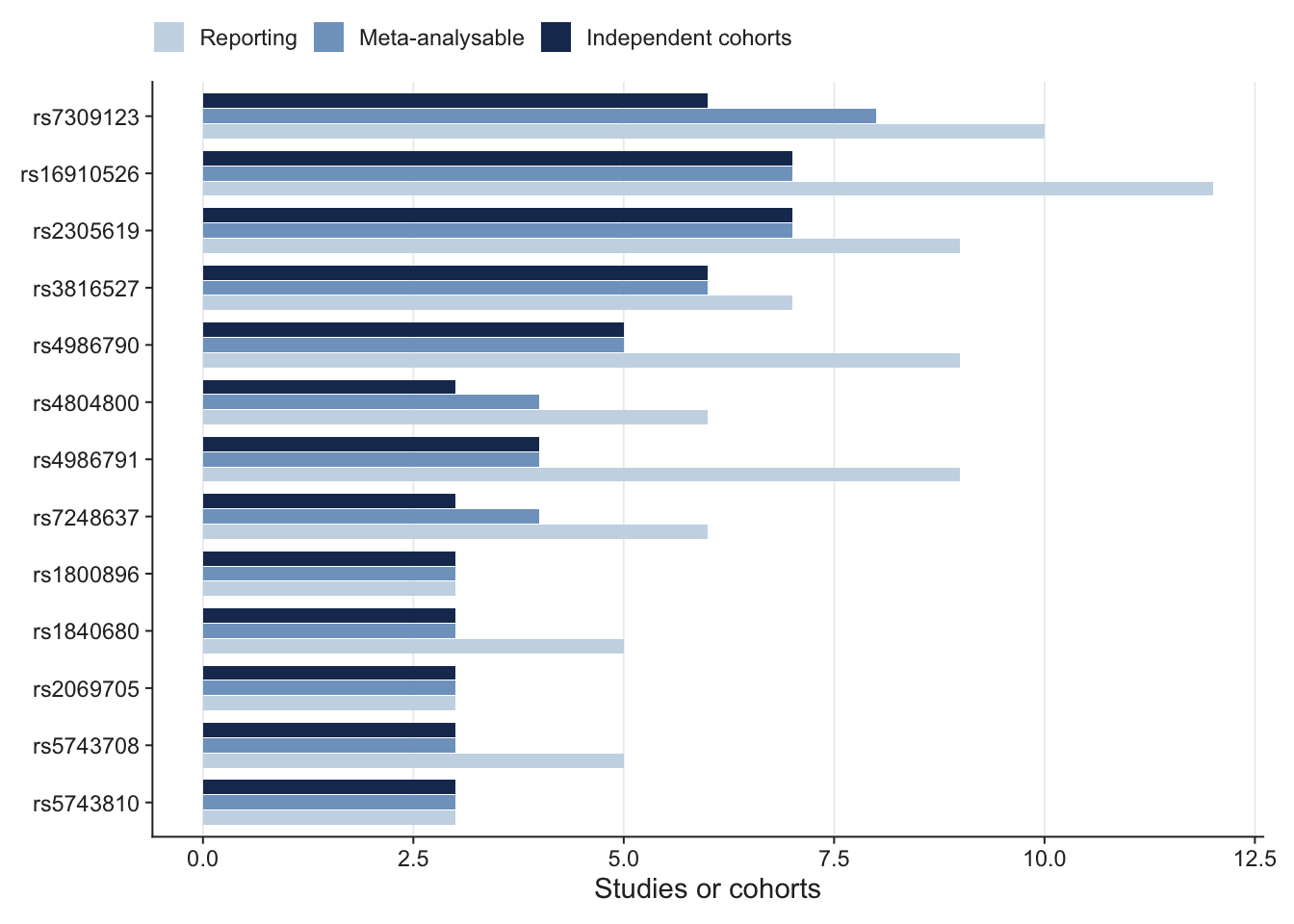
Reported alleles were compared with the alleles segregating in Europeans in dbSNP. A flipped strand inverts the risk allele and so the sign of the modelled effect.
tibble(
  Flag = c("fwd_ok", "strand_flip", "palindromic_unresolvable (A/T or C/G)", "single_allele_only",
           "no alleles reported", "mismatch (allele absent from dbSNP)", "no valid rsID"),
  Rows = c(701, 188, 130, 234, 444, 4, 306)
) |> gt() |> fmt_integer(Rows)| Flag | Rows |
|---|---|
| fwd_ok | 701 |
| strand_flip | 188 |
| palindromic_unresolvable (A/T or C/G) | 130 |
| single_allele_only | 234 |
| no alleles reported | 444 |
| mismatch (allele absent from dbSNP) | 4 |
| no valid rsID | 306 |
Within the panel, the affected variants are rs16910526, rs1800896, rs2069705 and rs5743810 (10 study by variant cells). All are handled by complementing the alleles.
rs7309123 is a C/G palindrome, so its strand cannot be settled from the allele letters. It was resolved study by study from control allele frequencies, primer sequences and full texts (addenda 16, 19 and 21).
read.csv("data/rs7309123_strand_resolution.csv") |>
  transmute(Study = paste(first_author, year), Ancestry = ancestry, Strand = gsub("_", " ", strand_conclusion),
            Grade = grade, `In primary analysis` = ifelse(use_in_primary, "yes", "no")) |>
  arrange(Grade, Study) |>
gt()| Study | Ancestry | Strand | Grade | In primary analysis |
|---|---|---|---|---|
| Chen 2019 | Chinese Han | same as forward | A | yes |
| Fisher 2017 | European | same as forward | A | yes |
| Kalkanci 2020 | Turkish | same as forward | A | yes |
| Schnetzke 2024 | European | same as forward | A | yes |
| Tanpaibule 2020 | Thai | same as forward | A | yes |
| Sainz 2012 | European (Spanish) | same as forward | B | yes |
| Fischer 2015 | European (Jena AML cohort) | same as forward | C | no |
| Fischer 2016 | European (Jena AML cohort) | same as forward | C | no |
| White 2018 | European (Welsh) | same as forward | C | no |
| Zhao 2022 | Chinese Han | undetermined | D | no |
Every row read from a comparison text with no reference marker was checked against its source table. Each correction is logged with its evidence.
read.csv("data/direction_check_log.csv") |>
  transmute(Study = study, `Rows without a reference marker` = rows_without_reference_marker, Verdict = verdict,
            Corrections = corrections) |>
gt()| Study | Rows without a reference marker | Verdict | Corrections |
|---|---|---|---|
| Tang 2020 | 60 | first-named group is the numerator in every row | |
| Herrero-Sanchez 2018 | 41 | reference label reversed in the source: corrected | 30 rows (data/extraction_corrections.csv) |
| Sainz 2012 | 19 | one row reversed: corrected; others correct | V0261 |
| Fischer 2016 | 9 | reference group listed first: all rows corrected | 12 rows (V1681-V1684, V1690-V1697) |
| Chen 2019 | 2 | first-named genotype is the numerator in every row | |
| Tanpaibule 2020 | 9 | first-named group is the numerator in every row | |
| Fisher 2017 | 3 | carriers of the minor allele (dominant) and minor-allele homozygotes (recessive) are the numerator | |
| Lupianez 2015 | 2 | not checked |
corr <- read.csv("data/extraction_corrections.csv")
n_dir <- sum(corr$study_id %in% c("S035", "S073", "S071"))
data/extraction_corrections.csv holds 71 corrected rows across 6 studies. 43 correct a reversed direction: Herrero-Sanchez 2018, Fischer 2016 and one row of Sainz 2012. The remaining 28 makes a comparison text readable (Tanpaibule 2020). Only Lupiañez 2015’s two IFNG rows were left unchecked, and IFNG is no longer in the panel.
As at 16 October 2026. Since then, the full texts of Kalkanci 2020, Chen 2019 and Fisher 2017 were supplied and read (addenda 19 and 20).
| Gap | Cells | Route |
|---|---|---|
| Counts in a supplement not supplied | 9 | Retrieve supplement |
| Estimate printed but no nucleotide allele anywhere | 10 | Author contact, or drop |
| Reported as a null with no numbers | 3 | Author contact |
| Data only inside a figure | 2 | Author contact |
TLR4 is usable only through genotype counts. Every contributing cohort has zero minor homozygotes in cases and controls, so only a carrier model is estimable and a continuity correction is needed.